Stakefish or solo ETH staking: fees and control
Classic Staking lets you use Stakefish to run a native Ethereum validator while you control the withdrawal address. Solo staking also puts the node and validator signing keys under your management. Both require at least 32 ETH to activate a validator. The choice depends on the commission applied to rewards, the cost of operating the node, and the responsibility that you want to retain.
Last updated:Operating work and key control
| Responsibility | Stakefish Classic Staking | Solo Ethereum staking |
|---|---|---|
| Validator operation | Stakefish runs the infrastructure and handles validator signing duties. | You operate the node, secure the validator signing keys, and maintain the software. |
| Withdrawal authority | You retain control of the withdrawal credentials, separately from the keys that Stakefish uses for validator duties. | You manage both validator signing and withdrawal authority. |
| Execution-reward distribution | Retail execution rewards flow through the MAX MEV smoothing pool and its distribution contract, subject to the applicable commission. | Without a separate smoothing arrangement, execution income depends on your validator's own block proposals. |
Solo operation requires maintaining execution and consensus clients, applying software upgrades, and responding to outages. Using Stakefish transfers node operation to the provider, whose performance still affects the validator's earnings. Downtime can reduce earnings and incur penalties in either model; conflicting validator signatures can cause slashing. Control of the withdrawal address does not prevent those operational losses.
Commission, running costs, and reward timing
Stakefish's Ethereum staking: In-depth guide on rewards & commission , updated in June 2026, records a change from 25% to 50% commission on execution-layer rewards while keeping consensus-layer commission at 0%. The guide presents this as the standard schedule; institutional clients have separate pricing. The Classic Staking calculator shows the same 0% and 50% split.
Stakefish or solo ETH staking: Fees and control
- Operating work and key control
- Commission, running costs, and reward timing
- Exits and payout behavior after Pectra
The Classic Staking FAQ also says that Stakefish retains 100% of execution rewards "since Glamsterdam", while its Glamsterdam guidance describes preparations before Ethereum mainnet activation and quotes 50%. These published fee descriptions conflict. Confirm the execution-reward rate and its effective date for the staking arrangement being offered before relying on a net-return estimate.
Under the June guide's schedule, the 50% charge applies only to execution rewards, including priority fees and MEV. Deposited ETH and consensus rewards are outside that fee base. The commission as a share of total rewards therefore changes with the relative contribution of execution income. Solo staking avoids a staking-service commission, but its net return must account for equipment, power, connectivity, and maintenance.
Reward timing also affects comparisons. Stakefish's smoothing pool shares execution income across participating validators, reducing dependence on an individual validator's proposal luck. An unpooled solo validator receives execution income when it proposes blocks. Compare the same reward streams over the same period, and distinguish earnings from wallet payments: consensus rewards can remain inside a compounding validator. Smoothing does not guarantee a fixed APR.
Exits and payout behavior after Pectra
Pectra activated on Ethereum mainnet on May 7, 2025, and introduced withdrawal-address-authorized exits through EIP-7002. For an eligible validator with
0x01
or
0x02
credentials, the registered withdrawal address can authorize an exit request without the validator signing key. This changes the older concern that an operator must always sign an exit. It is a protocol capability, and a request still has to pass through network processing, the exit queue, and withdrawal processing before the balance reaches the withdrawal address.
The withdrawal credential type also determines how consensus rewards leave an active validator. With
0x01
credentials, balance above 32 ETH is swept automatically to the withdrawal address. With
0x02
credentials, rewards can compound up to a 2048 ETH effective balance. Requested partial withdrawals can release balance above 32 ETH, while automatic sweeps apply only above 2048 ETH. Older
0x00
credentials need to be updated before withdrawals are possible.
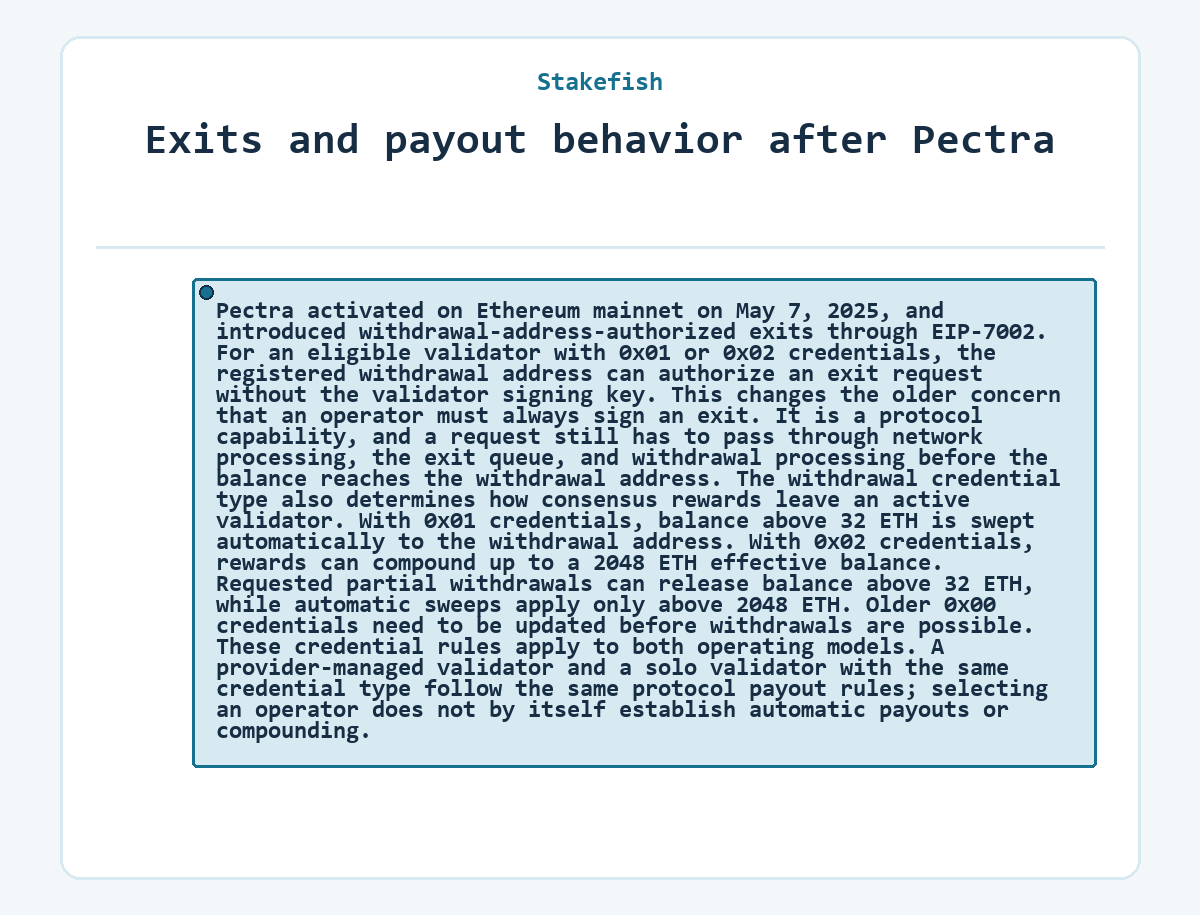
These credential rules apply to both operating models. A provider-managed validator and a solo validator with the same credential type follow the same protocol payout rules; selecting an operator does not by itself establish automatic payouts or compounding.
Decision checklist
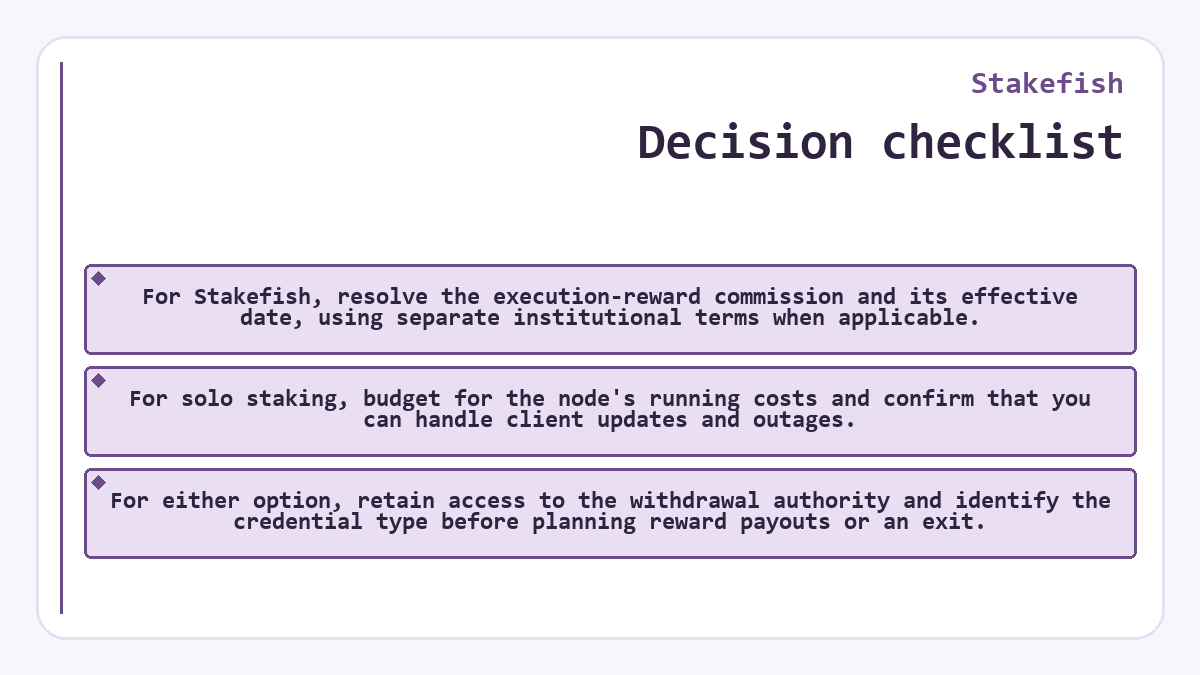
- For Stakefish, resolve the execution-reward commission and its effective date, using separate institutional terms when applicable.
- For solo staking, budget for the node's running costs and confirm that you can handle client updates and outages.
- For either option, retain access to the withdrawal authority and identify the credential type before planning reward payouts or an exit.