Stakefish staking API
Platforms can integrate stakefish's Ethereum staking service into their own applications to create and manage validators, monitor performance, track rewards, and request withdrawals. stakefish operates the validator infrastructure. Ethereum's network rules govern activation, withdrawal authorization, and completion.
Last updated:How does validator management relate to activation?
Ethereum requires a deposit of at least 32 ETH to activate a validator. New validators pass through an activation queue before they begin earning rewards. A platform using the API needs to distinguish its validator-management operations from the validator's actual network state, including whether activation has occurred.
Since Pectra, a validator with compounding
0x02
withdrawal credentials can have an effective balance of up to 2048 ETH. Regular
0x01
validators retain a 32 ETH effective balance cap. Effective balance determines how much stake earns consensus rewards, so counting validators alone does not establish the amount earning rewards.
What should reward reporting distinguish?
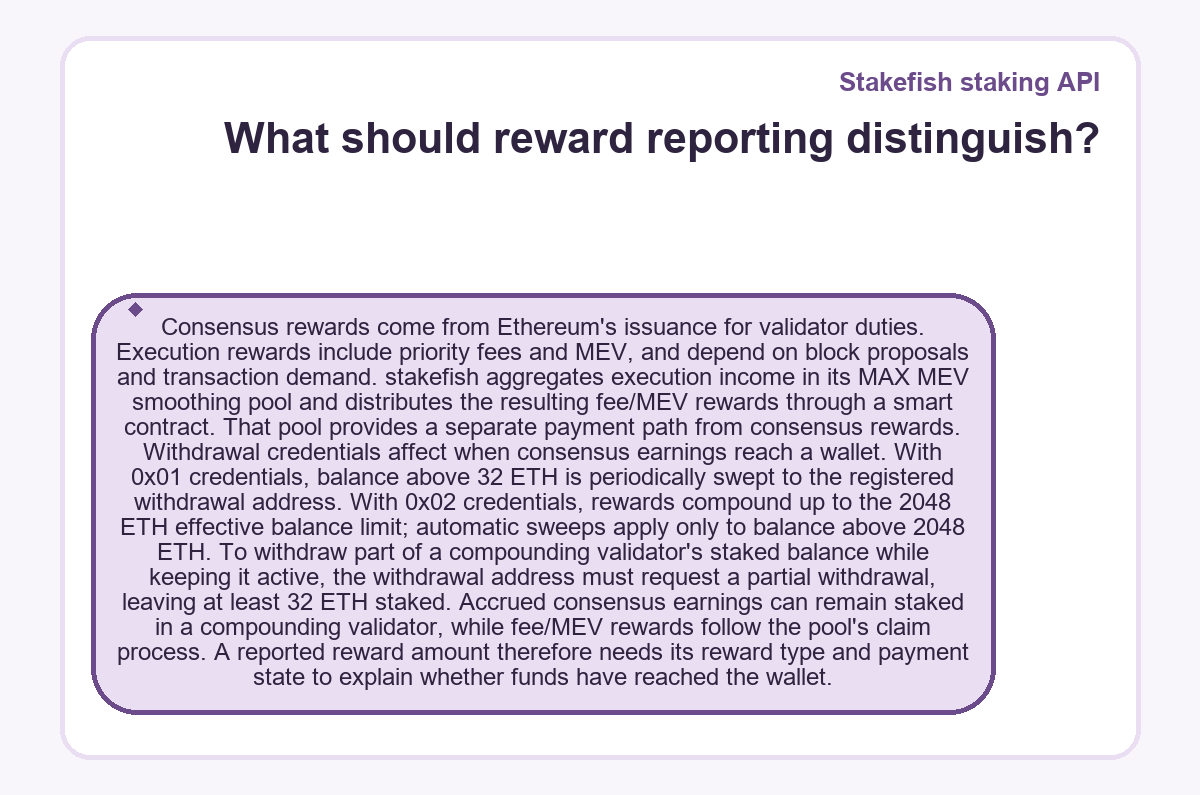
Consensus rewards come from Ethereum's issuance for validator duties. Execution rewards include priority fees and MEV, and depend on block proposals and transaction demand. stakefish aggregates execution income in its MAX MEV smoothing pool and distributes the resulting fee/MEV rewards through a smart contract. That pool provides a separate payment path from consensus rewards.
Withdrawal credentials affect when consensus earnings reach a wallet. With
0x01
credentials, balance above 32 ETH is periodically swept to the registered withdrawal address. With
0x02
credentials, rewards compound up to the 2048 ETH effective balance limit; automatic sweeps apply only to balance above 2048 ETH. To withdraw part of a compounding validator's staked balance while keeping it active, the withdrawal address must request a partial withdrawal, leaving at least 32 ETH staked.
Accrued consensus earnings can remain staked in a compounding validator, while fee/MEV rewards follow the pool's claim process. A reported reward amount therefore needs its reward type and payment state to explain whether funds have reached the wallet.
What does a withdrawal request accomplish?
Withdrawal requests are part of stakefish's documented Ethereum API capabilities. For a full validator withdrawal, the network must process the exit and withdrawal before the remaining balance reaches the registered withdrawal address. Submitting a request does not establish that the funds have arrived, and network queue conditions affect completion time.
The Pectra upgrade, activated on May 7, 2025, introduced execution-layer-triggered exits through EIP-7002. For validators with
0x01
or
0x02
withdrawal credentials, an authorized request from the registered withdrawal address can trigger a full exit without the validator signing key. This is an Ethereum protocol capability; the authorization flow and withdrawal operations exposed by a particular API integration still need to match that validator's credentials.
How does multi-chain support change the integration?
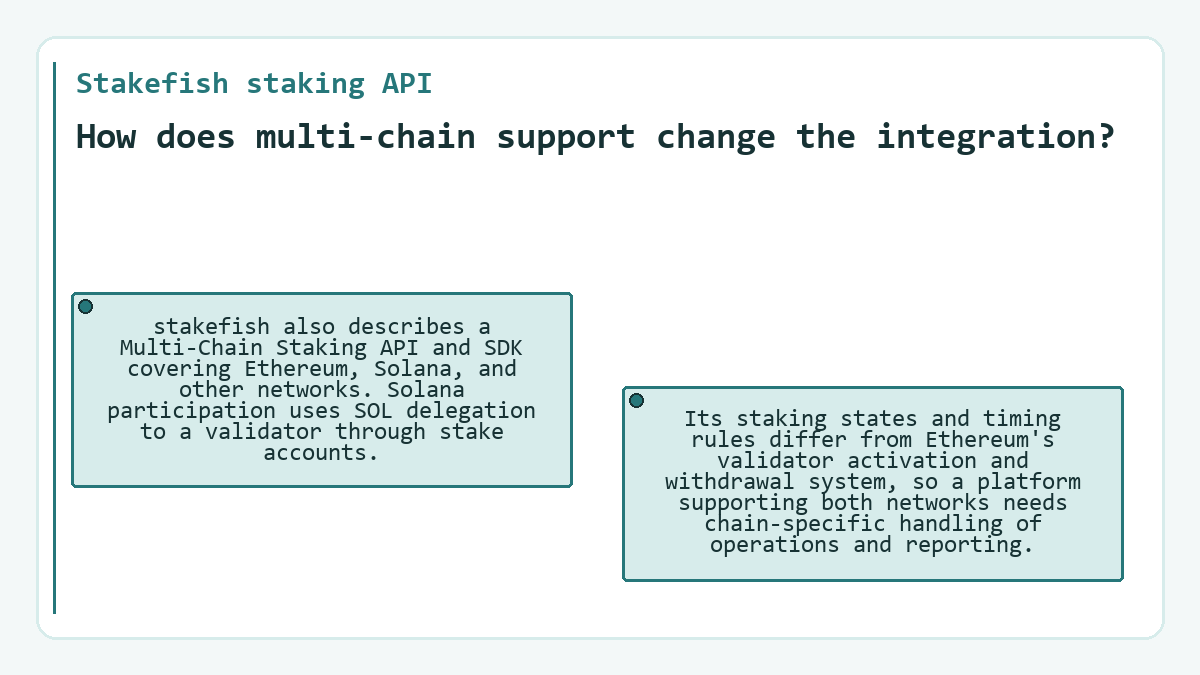
stakefish also describes a Multi-Chain Staking API and SDK covering Ethereum, Solana, and other networks. Solana participation uses SOL delegation to a validator through stake accounts. Its staking states and timing rules differ from Ethereum's validator activation and withdrawal system, so a platform supporting both networks needs chain-specific handling of operations and reporting.
Decision checklist
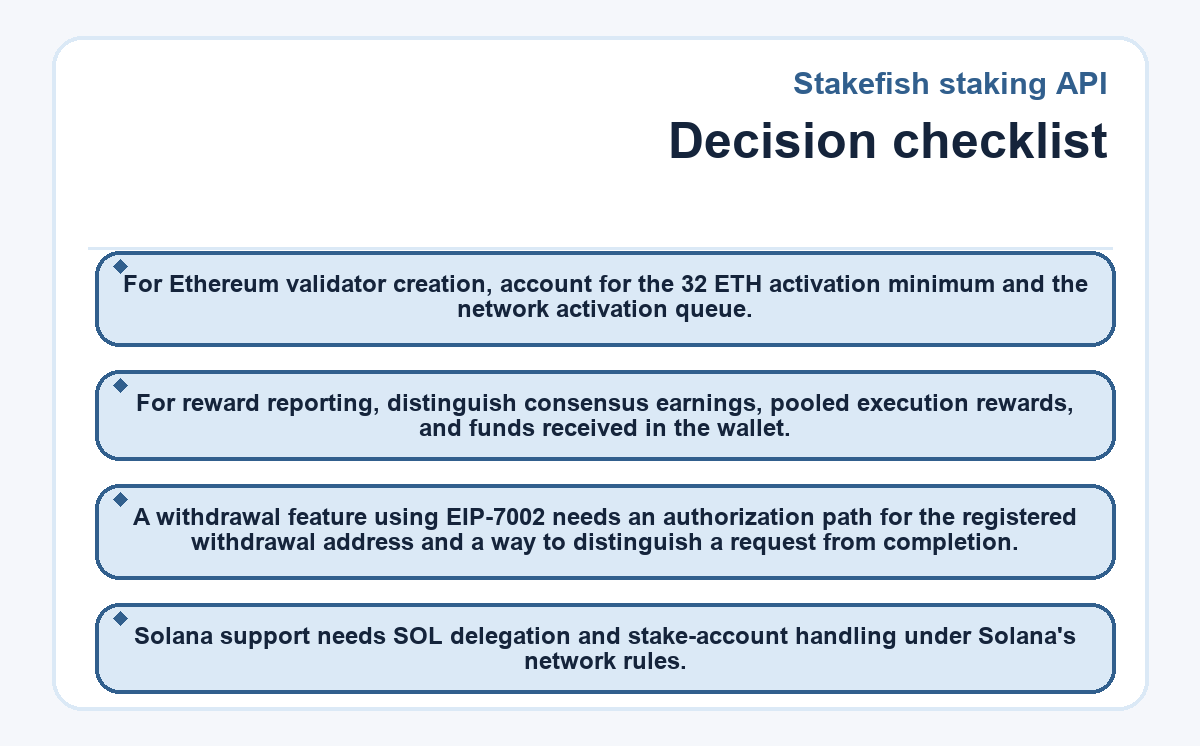
- For Ethereum validator creation, account for the 32 ETH activation minimum and the network activation queue.
- For reward reporting, distinguish consensus earnings, pooled execution rewards, and funds received in the wallet.
- A withdrawal feature using EIP-7002 needs an authorization path for the registered withdrawal address and a way to distinguish a request from completion.
- Solana support needs SOL delegation and stake-account handling under Solana's network rules.